
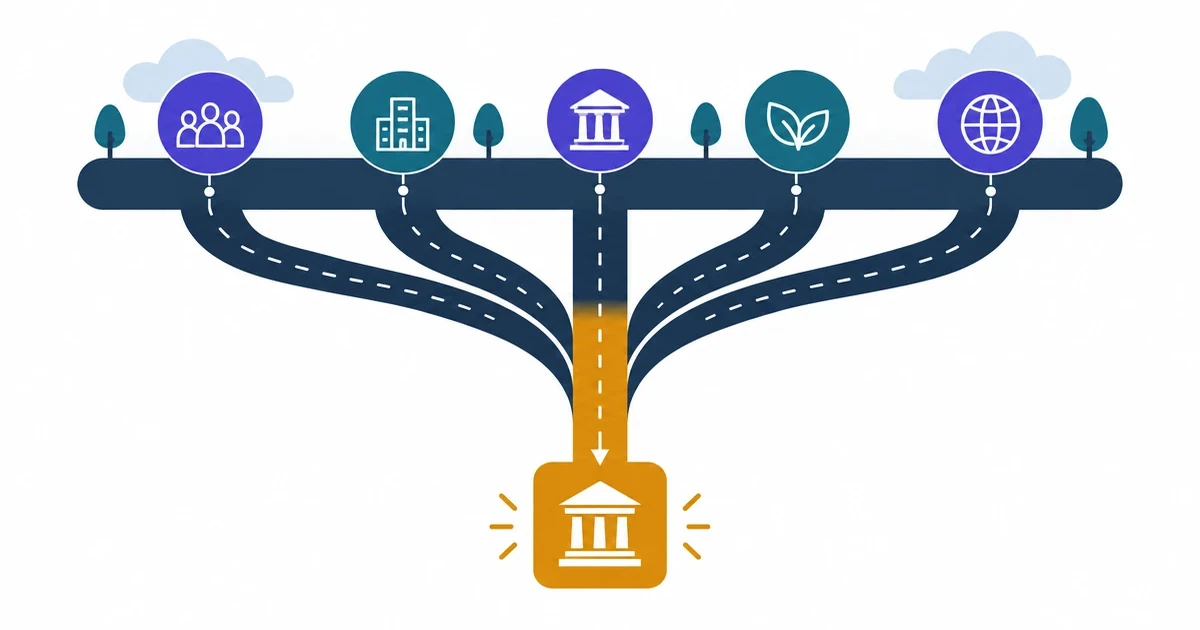
Across the public sector, the enabling layer of digital government is maturing. Cloud platforms are procured, identity and payment services are in place, and AI assistants are being rolled out to public servants. These are necessary investments.
And yet, for most citizens, the experience of applying for a permit, claiming a benefit or waiting on an inspection has not changed very much. The platform is there. The department’s process is not.
Want to pressure-test this against your own process? A Process Assessment turns the idea into a mapped process, a baseline and a recommended first pilot.
Start with an assessmentPlatforms and assistants are not processes
A platform provides capability: hosting, identity, data services, integration. An assistant helps an individual public servant draft, search and summarize. Neither of them, on its own, shortens a permit queue or creates an audit trail for a claim decision.
That work happens at the level of a single process inside a single department: how an application arrives, who checks it for completeness, how it is routed, who decides, how the decision is recorded, and how the applicant is told. That process was usually designed around paper, email and the knowledge of a few experienced officers. Putting it on a new platform without redesigning it simply moves the backlog.
Why the last mile is where it stalls
There are three recurring reasons.
First, capacity. Departments are running live services with limited staff. The people who understand the process best are the people who cannot be spared to redesign it.
Second, accountability. A public body must be able to show who made each decision, on what basis, and in line with which rule. AI that cannot show its work is, rightly, not allowed near consequential decisions — so pilots stall at the point where they would have to be trusted.
Third, measurement. Without a baseline — how long cases take today, how many are incomplete on arrival, how many are reworked — there is no way to show the improvement, and no case for extending it to the next department.
What last-mile delivery looks like
Last-mile delivery is deliberately narrow. Take one process with an accountable officer and a visible backlog. Spend the first weeks understanding it: interviews with the people who do the work, following real cases end to end, mapping every step and exception, capturing the baseline, and screening the data-protection implications.
Then rebuild it on the platforms the government has already chosen. Use AI where it earns its place — checking completeness at arrival, extracting data from documents, drafting summaries for an officer to review — and design human approval into every consequential decision. Record every action against the case.
Finally, prove it. Measure against the baseline, document everything, train the department’s own staff, and hand the system over. A result the department can run itself is worth more than a result that depends on the people who built it.
What leaders should ask for
If you are responsible for a department’s service, ask any proposal three questions. Which single process will be rebuilt, and who is accountable for it? What is the baseline, and how will the improvement be measured? Where, exactly, does a public servant approve a decision, and how is that recorded?
Platforms and assistants are the foundation. The value arrives one department, one process, one measured result at a time.